Why Your Coffee Tastes Different in Flight
And Why Tomato Juice Suddenly Makes Sense
If you know me, you know I love a good cup of coffee.
And if you’ve flown with me, you’ve probably noticed I never drink one in-flight.
The exact same espresso capsule I use at home tastes completely different once we’re airborne - sharper, slightly sour, and missing that smooth, full-bodied feel I expect.
And the regular brewed coffee served on most commercial flights is simply not something I personally choose to drink.
So what’s going on?
Why do Arpeggio and Istanbul taste one way in my kitchen and another way at 38,000 feet?
When we talk about “taste,” we usually mean flavour. But flavour is a combination of several systems working together: what your tongue detects (sweet, salty, sour, bitter, umami), what your nose detects (which accounts for most of flavour) and the physical sensations in your mouth like heat, spice, texture or carbonation.
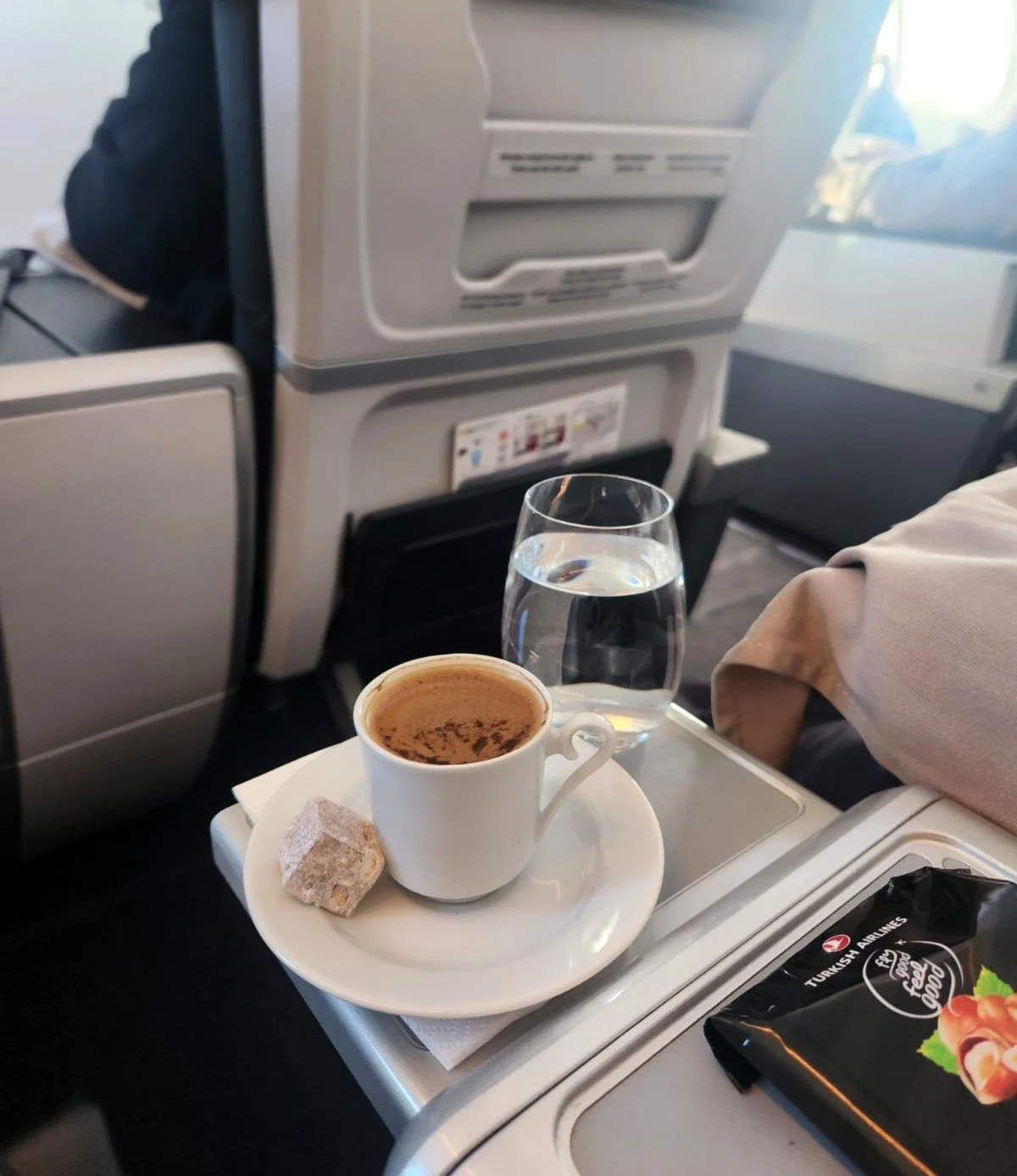
I was excited for the traditional Turkish coffee on TK (perfectly made) but that’s one affair I prefer at sea level.
Coffee relies heavily on smell. When your ability to detect aromas drops even slightly, the flavour changes. The brighter acids and bitter notes become more noticeable because the deeper aromatic layers are less available. That’s why coffee can feel sour and bitter in the air.
Aircraft cabins are pressurised, but not to sea level. Studies using simulated flight conditions show that lower pressure can reduce how well people detect smells and certain tastes. When aroma detection weakens, flavour loses complexity. Subtle notes are harder to pick up. Drinks like coffee and wine are especially affected because their character depends on layered aromatic compounds. The environment alters how your sensory system performs.
Humidity plays a role too. Cabins are dry. When your mouth is dry, saliva changes. Saliva helps dissolve flavour molecules and allows them to interact properly with taste buds. When that process changes, flavours don’t come together the same way. They can come across sharper or less balanced. If you drink water before coffee and notice the taste improves, that’s your physiology adjusting.
Noise is another factor most people don’t consider. Cabins are loud, and sound influences how the brain processes food. Controlled research simulating aircraft noise shows that sweetness can become less noticeable in loud environments, while savoury flavours often remain stronger by comparison. There is also a physical connection involved. The chorda tympani, a branch of the facial nerve carrying taste signals from the front of the tongue, runs through the middle ear. Because of that pathway, auditory stimulation can influence taste perception. In a loud, vibrating cabin, your brain interprets flavour differently than it does in a quiet kitchen.
Not everyone experiences these changes the same way. Even on the ground, people vary in taste sensitivity. Some are highly sensitive to bitterness. Others barely notice it. Some rely strongly on aroma. Others respond more to salt or texture. I once had a passenger on a private jet ask me to open four different bottles of red wine (mind you, they were all high quality french red wines) because none tasted right to him, while his companions enjoyed every one. Same aircraft. Same wine. Different perception. Cabin conditions can make those individual differences more noticeable.
Certain foods are more likely to taste different in-flight. Sweet foods and drinks often feel less intense. Lightly seasoned meals can seem flat. Aroma-driven drinks like coffee and lighter wines lose some of their character. Dishes built around subtle balance struggle more. On the other hand, foods rich in umami (tomato, parmesan, mushrooms, soy, miso) tend to hold up better. Well-seasoned, saucy meals perform more reliably than dry ones. Acidic components like citrus or pickles, along with ginger, chilli and warm spices, cut through more effectively. Crunchy textures also help because texture becomes more noticeable when flavour softens.
This explains the tomato juice phenomenon. Tomato juice is savoury, slightly salty, acidic and naturally high in umami. When sweet notes become weaker, and there is less aroma coming through, savoury (umami) flavours become more noticeable. That’s why tomato juice can feel surprisingly satisfying during a flight, even for people who would never order it on the ground.
If you want food to remain satisfying at cruising altitude, aim for umami, salt and acidity. Look for texture contrast. Opt for meals with sauces rather than dry components. Delicate flavours tend to fade more easily. Bold, structured flavours cope better with cabin conditions.
You can’t change cabin pressure, humidity or noise. You can choose what you eat. Salted or spiced nuts, biltong or jerky if sodium suits you, parmesan bites or aged cheese on short sectors, olives, hummus with crackers, tuna or salmon pouches with rice crackers, dark chocolate with nuts - these options tend to work better in-flight because their flavours carry through.
And about the coffee… if you’re going to have one up there, hydrate first and choose a stronger profile than you would at home. Just know it won’t taste the same. Some rituals simply belong on the ground. Once you understand how the cabin reshapes your senses, you stop being disappointed by the cup in your hand - and start planning your favourites for your days off.
Stay nourished,
Ivana