The Training Every Crew Hates… and the Reason It Works
Recurrents.
Raise your hand if you ever saw recurrent training on your roster and thought, “Fantastic. I can’t wait.”
Exactly.
Most crew have the same reaction.
You get your roster. You notice those recurrent training days sitting there between flights and days off, and the process begins. Manuals come out again. Someone always asks the classic question:
“Does anyone know what the latest exam questions are?”
“What sim scenarios are they running this year?”
And no matter how many times you’ve done it, there is always a little tension around it. You already know roughly how it will go. There will be a scenario to run as a team. You will open a door in normal operations. Then open it again in emergency mode. You will shout commands that every crew member on the planet knows by heart. Maybe there will be smoke procedures. Maybe a medical scenario.
And even if you do everything well, you will still repeat it again next year. And the year after that.
There is a deeper reason why aviation insists on this routine. And it has very little to do with renewing your license.
It has everything to do with how the human brain behaves when things go wrong.
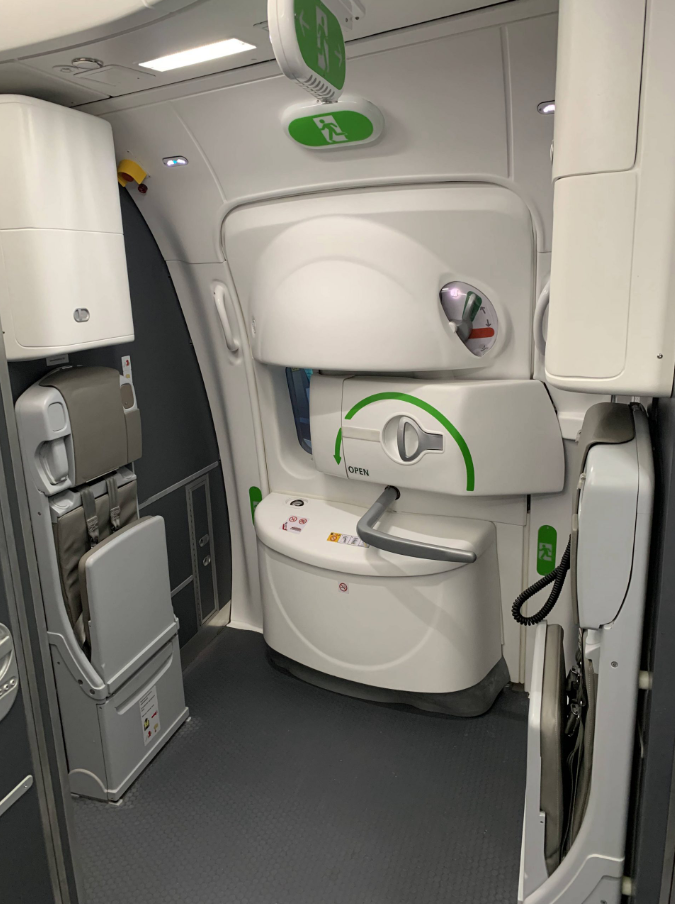
Boeing 787 door trainer.
Image credit: Spatial Aero
I have been on both sides of recurrents. I attended recurrent training like any other crew, and I facilitated hundreds of them. So I know both perspectives very well. I know the crew side. Studying again. Wondering which sim scenario will come up. Feeling that relief when the exam and the practical assessment are finally over.
And I know the instructor side too. Watching how repetition slowly turns procedures into something that the crew perform almost automatically.
Which brings us to the interesting part. Let’s look at the biology behind why aviation loves repetition so much. What happens to your brain in a real emergency?
Imagine something serious happening during a flight: a fire in the cabin, a passenger collapsing, an evacuation.
The body reacts instantly.
The brain detects danger through a small structure called the amygdala. Within seconds, hormones like adrenaline and noradrenaline flood the bloodstream. Heart rate goes up, we breathe faster, and we are focused on the situation in front of us. Everything else goes on “mute“. Your entire system is preparing you to act quickly. This response is incredibly useful because it helps us move fast and stay alert.
But it also comes with an interesting side effect.
The part of the brain responsible for careful thinking and detailed analysis, the prefrontal cortex, becomes less efficient. In very simple terms, during high stress, the brain is not designed for slow reasoning or complex analysis. Instead, it relies on something else.
Deep inside the brain, there is another system responsible for automatic actions. This system is largely controlled by an area called the basal ganglia (hang in there, now it gets interesting). This is where the brain stores what scientists call procedural memory. Procedural memory is responsible for skills like riding a bicycle, typing on a keyboard, or driving a car. Once those skills are learned properly, you do not need to think through every step. You simply do them.
Under stress, the brain relies heavily on this automatic system. Instead of stopping to analyze each step, the brain retrieves the sequence it practised repeatedly. That sequence becomes the action. And this is exactly what aviation training is building.
Every time you practice a procedure, whether it is opening a door, running a checklist, or shouting evacuation commands, specific neurons (nerve cells) in the brain activate together. Each repetition strengthens the connections between those neurons.
There is a simple phrase often used to describe it: Neurons that fire together wire together.
With enough repetition, those pathways become stronger and faster. The brain also begins wrapping the nerve fibers involved in the skill with a fatty insulating layer called myelin. Think of myelin like insulation on an electrical cable. The better the insulation, the faster the signal travels, therefore, the brain can execute the action much faster and with much less effort.
This is why experienced crew can react quickly in situations that might overwhelm someone without training. Not because they are thinking faster, but because the brain already has a well-built pathway for the action.
Phew, that was a lot! Are you still with me?
So, to put it simply, in an emergency, you may have alarms sounding, passengers reacting emotionally, smoke reducing visibility, and multiple tasks happening at the same time. The brain cannot calmly analyze a complicated manual in those moments, but it can execute a well practiced routine. That is why aviation training is repeated again and again during initial training and then reinforced every year during recurrent training. The goal is not simply to remember the procedure. The goal is for the body to perform it automatically when stress is high.
When speaking with crew who have experienced real emergency situations on board, such as smoke in the cabin or performing CPR on a passenger, they often describe the same feeling afterwards. They rarely say they carefully analyzed the situation step by step. Instead they say something like this: “I didn’t even think. I just started doing the procedure.”
That is exactly what recurrent training is building. Not knowledge stored somewhere in a manual. But actions stored deep in the nervous system.
So the next time recurrent shows up on your roster
You will probably still roll your eyes.
You will still ask your colleagues what sim scenarios might come up.
You will probably still feel that little wave of tension before the exam.
But behind those few days in the classroom, there is something much bigger happening. Every time you repeat those drills, you are strengthening the neural pathways that allow your brain to respond quickly when something serious happens at 38000ft.
Which means that somewhere between rolling your eyes at the roster and shouting commands in the sim, your brain was preparing you to be very good at your job.
“Repetitio est mater studiorum”
Ivana